
The nearest stone has a clean boundary. Start there before following the softer shapes behind it.
INDEPENDENT VISUAL LABORATORY / AU EDITION
LOOK CLOSER.
A study of precious surfaces
and the light that gives
them a second life.
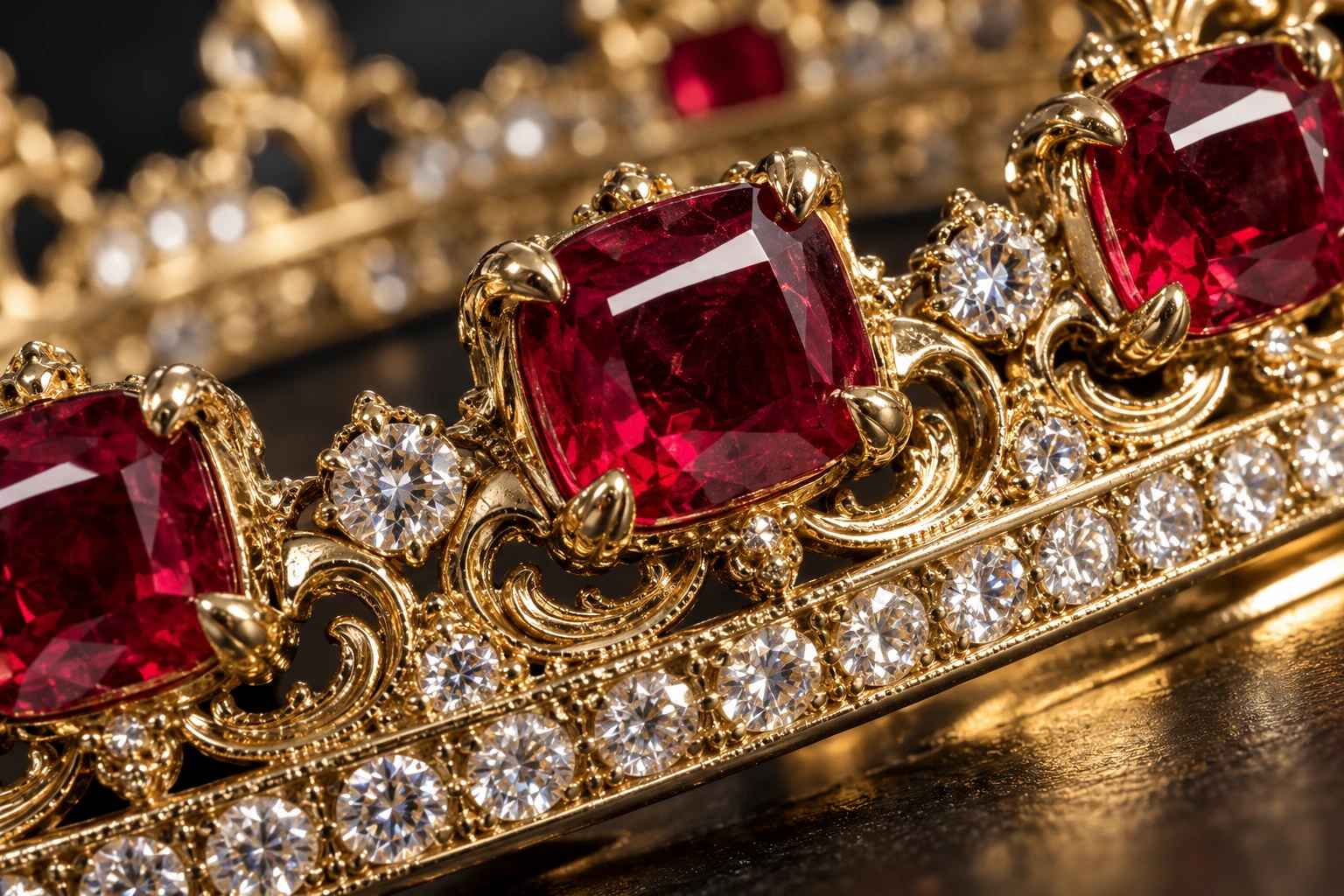
GOLD / RUBY / DIAMOND
At the edge of the crown.
Begin with a small detail. The whole story can wait.
Enter the light lab ↗OBSERVECHANGE ONE VARIABLECOMPAREASK AGAIN
The smallest edge.
The biggest change.
Gold, ruby and diamond become a world of surfaces when you move in close. A claw, a facet, a reflection: each changes how an object feels before you know anything about it.
Brinodexa pairs original photorealistic jewellery artwork with a working light experiment. The images are imagined; the questions are yours to explore.
Open the specimen notebook ↗BENCH 01 / INTERACTIVE OPTICSOne boundary.
One boundary.
A different direction.
Change the incoming angle and the two refractive indices. The diagram calculates an ideal ray at a flat boundary; it is not a measurement of the imagined jewellery.
RAY MODEL / FLAT BOUNDARYANGLES FROM NORMAL
IncomingRefractedDashed: reflected direction
Indices from 1.00 to 2.50. This is a simplified model.
REFRACTED ANGLE25.37°
The ray bends towards the normal.
No critical angle for this direction.n₁ sin θ₁ = n₂ sin θ₂
Ideal, uniform materials at one flat interface. The model does not calculate colour dispersion, absorption, brightness or an entire cut gemstone. Read the assumptions ↗
STUDY 02 / TRANSMITTED LIGHTBEYOND
BEYOND
THE SURFACE.
A ruby is more than a red silhouette. In this imagined close study, light reveals a web of finer shapes within.
LOOKING PROMPT
Separate the outside boundary from the internal detail. Which one did you notice first?
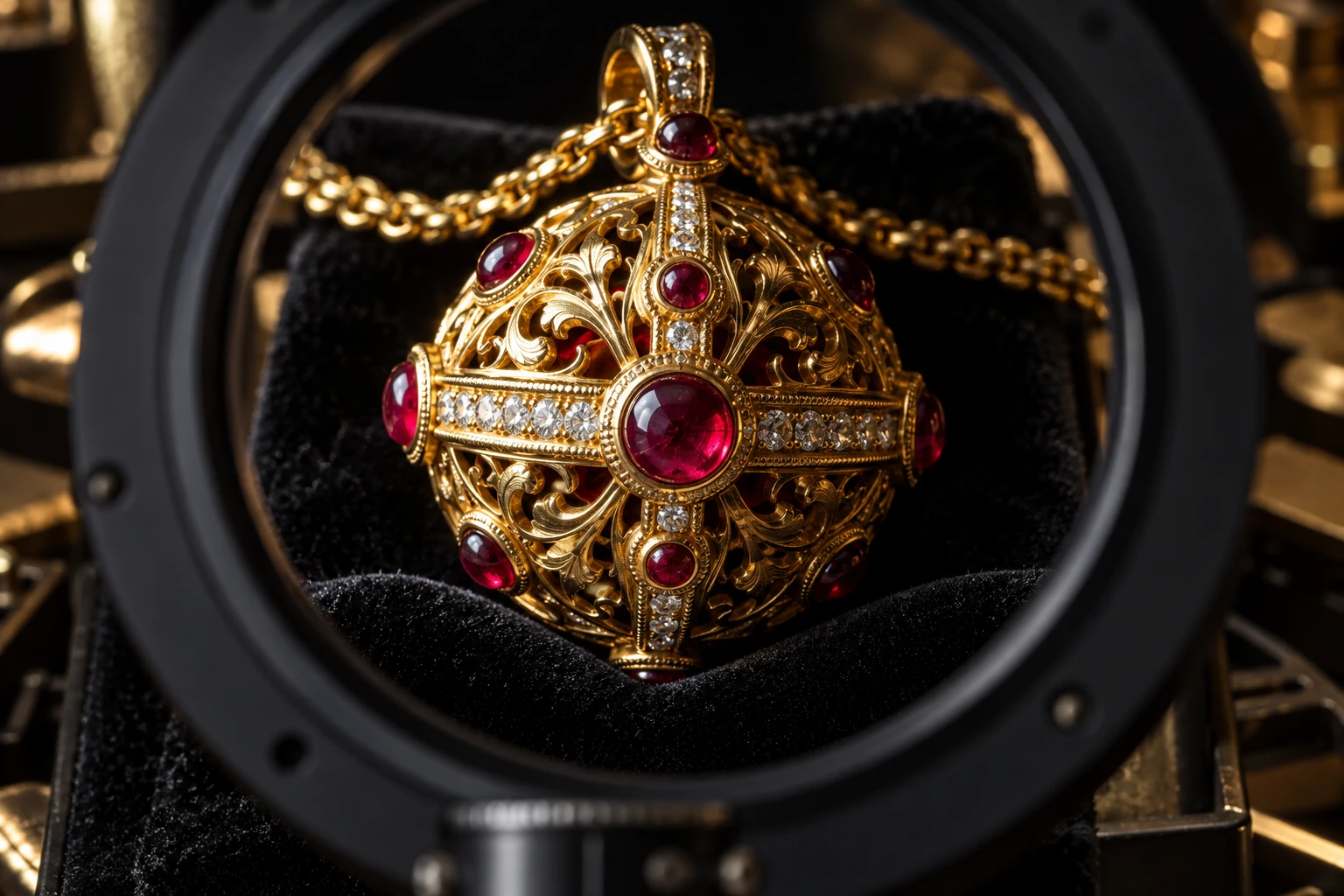
The loupe offers another view inside the same frame. Compare the large stone with its small reflection: the context changes even when the subject stays recognisable.
Read study 02 ↗STUDY 04 / SEQUENCE & FOCUS
A line of light.
Five settings become one curve. Sharp foreground detail and softer distance give this bangle a sense of direction.
Repeated round settings give the image continuity without making every diamond equally prominent.
A small spectral reflection interrupts the grey ground. It is an artistic cue, not a measured spectrum.
STUDY 03 / THE WORKED SURFACEPRECISION
PRECISION
LEAVES A TRACE.
A polished shoulder, a raised leaf, a fine tool at the edge. The signet study makes the act of looking feel almost tactile.
OBSERVATION 03.A
Follow the highlight across the ring. Its shape changes where the metal moves from a smooth curve into relief.
Read the surface note ↗BENCH 02 / A CONTROLLED VIEWRemove the noise.
Remove the noise.
Find the detail.
Use the viewing tools to inspect the pendant study. The grid and enlargement change your view of one image; they do not create new measurements.
Three things to notice
0 of 3 observations noted.
Nothing is saved automatically or sent to us.
FROM THE ORIGINAL NOTEBOOK
Two quieter studies.
A rough green ground. A sheet of pale paper. The original crystal and emerald scenes offer a useful contrast to the dark goldwork.
06 / CrystalA bright boundary meets a textured ground. Compare the clear form with the spread of colour around it.
07 / EmeraldA narrow tool gives the green stone a scale cue. The simple paper field keeps the geometry in focus.
A SMALL METHODBetter questions.
Better questions.
Not bigger claims.
These image studies cannot authenticate a gemstone or measure its quality. They can help you practise clear observation.
Read the complete notebook ↗- Describe
Name what you can actually see: an edge, a colour, a repeated curve.
- Change
Alter one setting in the light lab. Keep the other settings fixed.
- Compare
Read the new angle, compare the ray and explain the change in your own words.
- Record
Download the model values if you want a local record. A calculation is not a certificate.
WORKING VOCABULARYA few useful
A few useful
words.
Facet
A flat face on a cut form. In the image studies, look for the boundary between one face and the next.
Normal
The reference line perpendicular to the boundary in the light model. Both ray angles are measured from this line.
Refractive index
A parameter describing the speed of light in a medium relative to vacuum. The lab uses adjustable idealised values, not measurements taken from these images.
Critical angle
For a ray moving from a higher to a lower refractive index, the angle at which the refracted ray runs along the boundary. Above it, the ideal model shows total internal reflection.
What the images can tell you
They can support observation of composition and visual cues. They cannot establish a real stone’s identity, origin, value or grade.
Imagined specimens.
Real curiosity.
The seven image studies are original digital artworks created with generative tools. Brinodexa is an independent creative and educational experience, not a physical gem laboratory or a jewellery retailer.
About this laboratory ↗