
CHANGE THE ANGLE.
A small experiment with a clear result. Adjust one variable, watch the ray and compare the numbers.
One boundary.
A different direction.
Change the incoming angle and the two refractive indices. The diagram calculates an ideal ray at a flat boundary; it is not a measurement of the imagined jewellery.
Indices from 1.00 to 2.50. This is a simplified model.
The ray bends towards the normal.
No critical angle for this direction.Ideal, uniform materials at one flat interface. The model does not calculate colour dispersion, absorption, brightness or an entire cut gemstone. Read the assumptions ↗
Remove the noise.
Find the detail.
Use the viewing tools to inspect the pendant study. The grid and enlargement change your view of one image; they do not create new measurements.
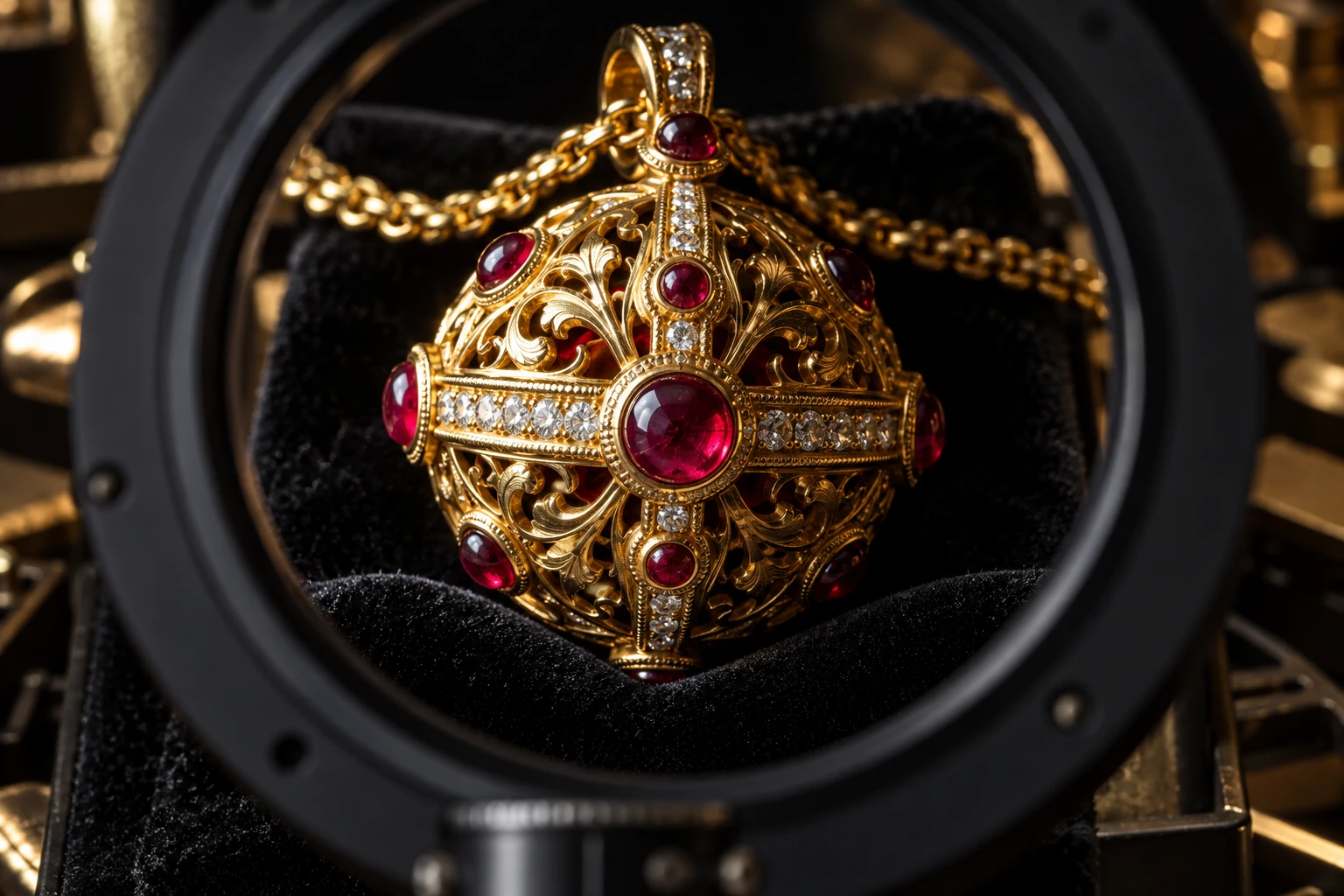
Three things to notice
0 of 3 observations noted.
Nothing is saved automatically or sent to us.
What is being calculated?
The model applies Snell’s law at one flat boundary between two ideal, uniform materials. It draws directions rather than light intensity. The faint reflected ray is a directional reference, not an energy calculation.
When the incoming material has the higher index, a sufficiently large angle can produce total internal reflection. In that state there is no propagating refracted ray in this model, and the readout says so instead of showing a made-up angle.
Indices must be from 1.00 to 2.50; the incoming angle runs from 0° to 85°. Invalid entries pause the calculation. Downloading stores the current values as a JSON file on your device.
Model notes and further reading ↗